Get 10% OFF on orders above Rs. 1,999.00
Rs. 200.00
FREE SHIPPING
Rs. 1,999.00
15% OFF

Get 10% OFF on orders above Rs. 1,999.00

Walk into any café with a matcha menu, or scroll any matcha brand’s website (including ours), and you’ll see the phrase everywhere: ceremonial grade. It sounds important. It’s usually more expensive. But ask most people what it actually means and you’ll get a shrug.
So let’s fix that. By the end of this post you’ll know exactly what ceremonial matcha is, how it’s made, why it costs what it costs, and crucially, why the label on its own guarantees absolutely nothing.
The Short Answer
Ceremonial matcha is the highest quality of matcha. It’s made from the youngest, most tender leaves of the very first spring harvest, shade-grown for weeks before picking, carefully de-stemmed and de-veined, and slowly stone-ground into an ultra-fine powder.
It’s called “ceremonial” because this is the grade traditionally used in the Japanese tea ceremony (chanoyu), where matcha is whisked with nothing but hot water and drunk plain. No milk, no sweetener, nothing to hide behind. That’s the real test: ceremonial matcha has to taste good on its own.
How Ceremonial Matcha Is Actually Made
The quality isn’t magic. It’s the result of very specific, very labour-intensive steps, and understanding them is the best defence against fake “ceremonial” claims.
1. Shading (this is the big one)

About three to four weeks before harvest, farmers cover the tea plants with shade cloths, cutting out most of the sunlight. Starved of sun, the plant panics, in a good way. It pumps chlorophyll into its leaves (that’s the electric green colour) and produces more L-theanine, the amino acid responsible for matcha’s sweet umami taste and its famous calm-alert effect.
Sun-grown tea, by contrast, converts theanine into catechins, which are healthy but bitter. This is why unshaded “matcha” tastes harsh. It’s chemistry, not bad luck.
2. First harvest only

The first flush of spring (usually April to May in Japan) produces the youngest, softest, most nutrient-dense leaves. Ceremonial matcha uses only these. Later harvests, second and third, go into culinary grades. The leaves are hand-picked or carefully machine-harvested, taking only the top few tender leaves of each shoot.
3. Steaming, drying, and de-stemming
The leaves are steamed within hours of picking to stop oxidation (this is what keeps matcha green rather than letting it brown like black tea). They’re then dried and sorted, with stems and veins painstakingly removed. What remains, pure leaf flesh, is called tencha.

4. Stone grinding
Tencha is ground between granite stone mills that turn slowly to avoid heat, since heat degrades flavour and colour. The pace is almost absurd: a traditional mill produces roughly 30 to 40 grams of matcha per hour. That’s one small tin taking over an hour of continuous grinding. When people ask why good matcha isn’t cheap, this is a big part of the answer.
Ceremonial vs Culinary: What’s the Real Difference?
|
|
Ceremonial |
Culinary |
|
Harvest |
First spring harvest |
Later harvests |
|
Taste |
Sweet, umami, smooth |
Robust, more bitter |
|
Colour |
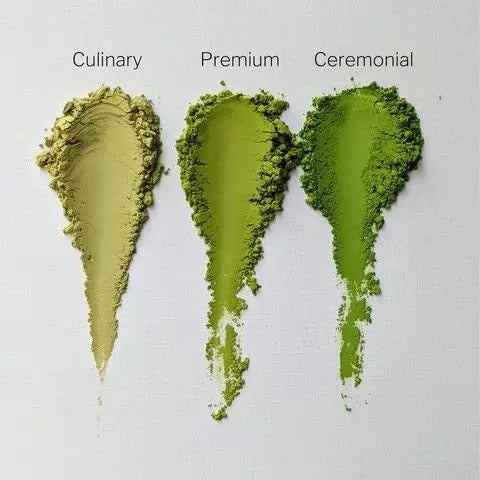
Vivid bright green |
Duller, olive-toned |
|
Best for |
Drinking plain with water |
Lattes, smoothies, baking |
|
Price |
Higher |
Lower |
Here’s the nuance most posts skip: culinary matcha is not “bad matcha.” It’s designed to punch through milk and sugar. Using delicate ceremonial matcha in a heavily sweetened iced latte is honestly a bit of a waste, like cooking with a Rs 6,000 single malt. Many serious matcha drinkers keep both: ceremonial for drinking straight, culinary for everything else.
The Uncomfortable Truth: “Ceremonial” Isn’t Regulated
This part matters, especially in India.
There is no legal or international standard for the term “ceremonial grade.” No certification body. No inspection. Any brand can print it on any powder, and in a fast-growing market like India’s, plenty do. We’ve seen dull, bitter, clearly late-harvest powder sold as “premium ceremonial matcha” at eye-watering prices.
So instead of trusting the label, check what the label should be backed by:
A brand that can’t or won’t tell you where and when its matcha was harvested is telling you something anyway.
Do You Actually Need Ceremonial Matcha?

Honest answer: it depends on how you drink it.
Yes, buy ceremonial if: you drink matcha plain (usucha style, just whisked with water), you’re sensitive to bitterness, or you want the full flavour experience. Once you’ve tasted proper first-harvest matcha, there’s no unknowing it.
Culinary is fine if: your matcha life is 90% lattes, smoothies, and baking. The milk and sweetener will mask ceremonial’s subtleties anyway, and a good culinary grade will actually taste more matcha-forward in a latte.
A good middle path: many people start with a quality latte-grade matcha, get hooked, and then buy a small tin of ceremonial for weekend “slow matcha” moments. Whisking a proper bowl on a Sunday morning is a small ritual worth having.
Brewing Ceremonial Matcha the Simple Way
You don’t need a tea ceremony. You need three minutes.
That’s it. Sweet, grassy, oddly calming. If it tastes harsh, either the water was too hot or the “ceremonial” label was doing some heavy lifting.
The Takeaway
Ceremonial matcha is real, and the difference is genuinely dramatic. But the word is just marketing until the powder proves it. Shade-grown, first-harvest, stone-ground, vividly green, smooth with plain water: that’s the standard. Hold every brand to it, including us.